28 Jun 2008 - permalink
Telia finally pulled the curtains on iPhone pricing and conditions in Denmark today. Unlike the other Scandinavian countries Sweden and Norway, Telia Denmark has only a single plan for each iPhone model.
The 8GB iPhone will set you back $296 (1399 DKK) while the 16GB model costs $423 (1999 DKK). Both include 6 months contracts (maximum in Denmark) with a monthly fee of $127 (599 DKK) comprised of 300 minutes (though unlimited to other Telia customers), unlimited SMS messages and 300MB of data. The total cost of ownership during the 6 months is thus $1057 (4993 DKK) and $1184 (5593 DKK) respectively.
I’m all in, especially considering I’m already spending around $100 a month using my current Nokia. Subtracting this from the TCO brings the cost of upgrading to the iPhone down to a fair $580. I’m a little worried that 300MB a month might not be enough, but it’s really hard to judge how much I’ll end up using 3G compared to WiFi and how much the Safari cache can save.
Compared to the Swedish and Norwegian iPhone plans the monthly fee is considerably higher but the contract runs for a minimum of 18 months. Here is comparable TCO for all three countries:
8GB:
- Denmark: $1075 (6mo)
- Sweden: $1755 (18mo, iMidi)
- Norway: $1819 (appears to be 12mo, Medium)
16GB:
- Denmark: $1184 (6mo)
- Sweden: $1890 (18mo, iMidi)
- Norway: $2000 (appears to be 12mo, Medium)
Both the Swedish and Norwegian contracts include 250 minutes, texts and MBs, selected as closest match. It would seem Danes get a better deal in all ways. Now, it’s only two weeks before the mayhem begins…
24 Jun 2008 - permalink
The world-renowned comedian George Carlin died yesterday at age 71. Famous for his provocative material and eloquent performances, Carlin perhaps said it best himself:
The most unfair thing about life is the way it ends. I mean, life is tough. It takes up a lot of your time. What do you get at the end of it? A Death! What’s that, a bonus? I think the life cycle is all backwards. You should die first, get it out of the way. Then you live in an old age home. You get kicked out when you’re too young, you get a gold watch, you go to work. You work forty years until you’re young enough to enjoy your retirement. You do drugs, alcohol, you party, you get ready for high school. You go to grade school, you become a kid, you play, you have no responsibilities, you become a little baby, you go back into the womb, you spend your last nine months floating …and you finish off as an orgasm.
And this brilliant take on modern communication, illustrative of his shows:
12 Jun 2008 - permalink
The third release of the web frontend for Xdebug by Jacob Oettinger and I is out today and contains a few new features like version checking, support for directly loading a specific report and a visual breakdown of internal, class and procedural functions and calls to include/require.
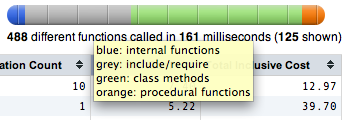
Jacob and I both appreciate the positive feedback our little project has recieved from the community. Please feel encouraged to submit any suggestions or comments, either here or on the Webgrind googlepage.
23 May 2008 - permalink
As part of my thoughts of data portability and its little sister ‘data share-ability’ through public APIs, I’ve created a Zend Framework based class for aggregating data streams from a few of the popular sites I use and sort them cronologically. Though the class itself is not ready for the public eyes, the result is a lifestream of (some of) my activities online, visible from the lifestream link in the menu.
While this provides a simple way of tracking my steps, it does not help me follow my friends. To remedy this, I’ve started working on an open social web application. It will provide a simple means of adding information on yourself and friends and an interface for following both.
The application will be a distributed social web and as such can be installed on any webhost. I believe this is key while waiting for the One True Portable Data Format as it puts the social relations in the hands of the user - where it belongs - and not in a data silo of a private company (Facebook anyone?).
The Dataportability Website is a great resource on the matter. There is a wealth of great and useful standards already defined; The biggest problem is getting them out there in big enough numbers for it to matter.
It is, in many ways, the problem of structured data versus the way humans think. Computers are rooted in logic and structures and though the thought of an ideal taxonomy of the world and us is appealing (at least to some), I don’t see it happen. The universe is a far too messy place for it to truly succeed (though Google seem to have a few tricks). Compare this to the enormous usage of the so-called folksonomy or use of tags. They are easy to use, have no cumbersome hierarchies and appear to work most of the time. They do give rise to synonyms, homonyms, and lack of normalization (stemming) - concepts humans navigate easily but computers need help with.
There are many problems on the way to realizing my application, let alone a standardized way of parsing human relations online. At the moment what I have is
- A proprietary model for storing account (e.g. kind and username) and contact information (using xfn markup) used by
- A class for parsing data feeds from service providers and outputting it in a consistent way as
- A data stream structure loosely based on RSS
For it to be of any real use, the application should to accept connections directly from service providers (flickr, twitter, etc.) rather than just from another installation of the application. It would also be immensely useful if it could parse and auto-discover any microformat markup encountered (other sites I use, people I know, personal info).
A successful solution cannot be accomplished by one man, but it is interesting to work on and the prototypes keep me updated on my friends :)
29 Apr 2008 - permalink
My about page has mentioned a web based frontend for Xdebug for some time. The project has a name now: The idea for Webgrind, a spin on Valgrind, came from lack of profiling tools for PHP, particularly on OSX. Though it is possible to install kcachegrind on osx it seems overkill for many uses and is definitely not as easy as unzipping a folder to the webroot.
After sitting on the idea for some time, I spoke with Jacob Oettinger about it and he promptly started on the foundation. What we have done up to this point is far from the power of kcachegrind, but it does allow for simple profiling in the browser to locate methods and functions most in need of optimization. Plus it installs in seconds.
I have since learned that the PHP group has a suggestion for a Google Summer of Code project that replicates the features of KCacheGrind as a web frontend. It seems Chung-Yang Lee has signed up for the challenge and it will be interesting to follow his progress.
We are currently making the last changes before releasing the first version on our Google code page for Webgrind. Please let us know what you think of this and of any ideas for future features. A downloadable package will be ready on Wednesday.
13 Apr 2008 - permalink
I forgot where I first saw this amazing demonstration of a sound recording and playback technology that preserves the spatial information required for the brain to hear the location of sound sources called Cetera.
Developed by hearing aid producer Starkey Labs, Cetera apparently is not a new technology. Audiology Online has an article about Cetera from 1999 but this is the first I’ve heard about it.
Sound is recorded by two microphones placed at a distance similar to that of the human ears and further processed to mimic the acoustics of the outer ear, and the result is unbelievably real. In the illustrational recording oh a virtual haircut, the electric razor feels eerily close to your ear! To experience the effect, headphones are needed:
Sajithmr has a full transcript of the dialogue and two more recordings.
If only this technique could be used in first-person computer games they would instantly become more immersive!
26 Feb 2008 - permalink
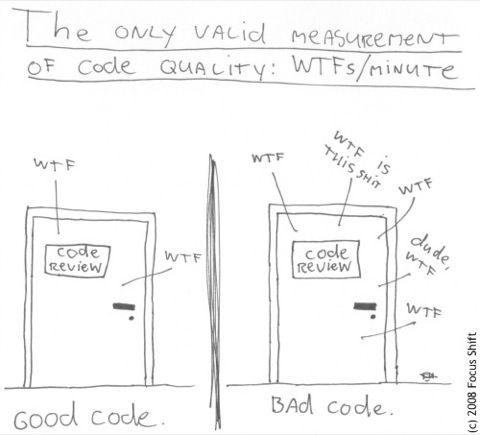
Too good not to post, I found this gem on OSNews FocusShift comic strip page. Brilliant!
18 Jan 2008 - permalink
My last two posts have been about opening the social web and I am obviously not alone in thinking greater interoperability would benefit providers and users alike. The net is buzzing with initiatives for opening the social graph and one of the most promising is the Dataportability Workgroup.
This brilliant video explains why data portability matters:
1 Dec 2007 - permalink
Aggregating content from a variety of sources through APIs is just a small part of the task of opening the web. While it allows me (the user) to present my online activities where I choose, it lacks the social relations.
There are currently hundreds if not thousands of takes on the social net and some of them take a more open approach than others. I recently re-discovered Plaxo, a site that first set out to keep your address book up to date and know includes a mashup timeline of user’s online events on other sites. My main gripe is that it requires registration to see the profiles. A site like SecondBrain is closer to what I want (and been building on this site): A public stream of activities that I’ve chosen to share with the world.
Though many sites allow for importing contacts from other sites like Gmail, LinkedIn, finding people you know is very much a manual and tedious process. How can the social relations be implemented in an open way re-using as much as possible of what is already out there and in a format that is readable by a computer?
Using the markup defined by XFN to add relationship information to hyperlinks, it is easy to see how one could build a parser to find these tags and build a social graph, one node at a time. Tagging urls as me, I could easily list urls to various sites I use and by doing so provide further data to the parser.
Aggregating personal data from your own sources and making it available in a standard format (RSS or some other XML/* structure) makes it possible for software (and users of it) to stay updated. Marking a link to a person (in the form of a website) as friend/family using the XFN markup would allow for certain types of data to be made available only to those relations. Best of all this could happen automatically. Brian Suda wrote an article on portable networks, touching on many of the same subjects.
Using OpenID could be a way of establishing a standardized (but distributed and open) identity online. In fact, it seems this is what ClaimID is all about, a site I’ve just discovered. Another very interesting project is the NoseRub protocol, an open source (MIT license) decentralized social network (also recently discovered and very similar in approach to my ideas). See also the wiki on open networking on the Microformats homepage.
I believe the combination of these existing technologies provides very promising tools of realizing the open social network, free of commercial interests and without giving away more control than absolutely necessary to make it all work. It would also seem that I either need to write a lot faster or seriously get involved in some of these projects as I discover tens of interesting resources, ideas and thoughts on the topic just be researching for these articles. Brilliant!
23 Nov 2007 - permalink
In a continuous effort to leverage the power of other sites like Flickr, I’ve integrated my Flickr photos in the blog list. Somewhat related to my thoughts on social networks and putting your content online, it is an example of pulling my data from a variety of sources and displaying them where I choose, here. It is also reminiscent of the mini feed on facebook.
Apart from spending time thinking about what I wanted, the programming didn’t take long - in great deal thanks to Zend Framework. It is my personal mashup.
I realize that most of this has already been done by software such as WordPress through it’s plugin architecture. It requires knowledge of programming and it does not include the crucial element of the social graph.
Grabbing updates from friends, however, would simply be a matter of changing the urls of the various services. As such it illustrates one of my key arguments against Facebook: The fact that Facebook is a walled garden, accessible only to members, prevents me from accessing from outside information about friends (or myself) from that small part of the internet.
Now, to solve the social graph problem…